
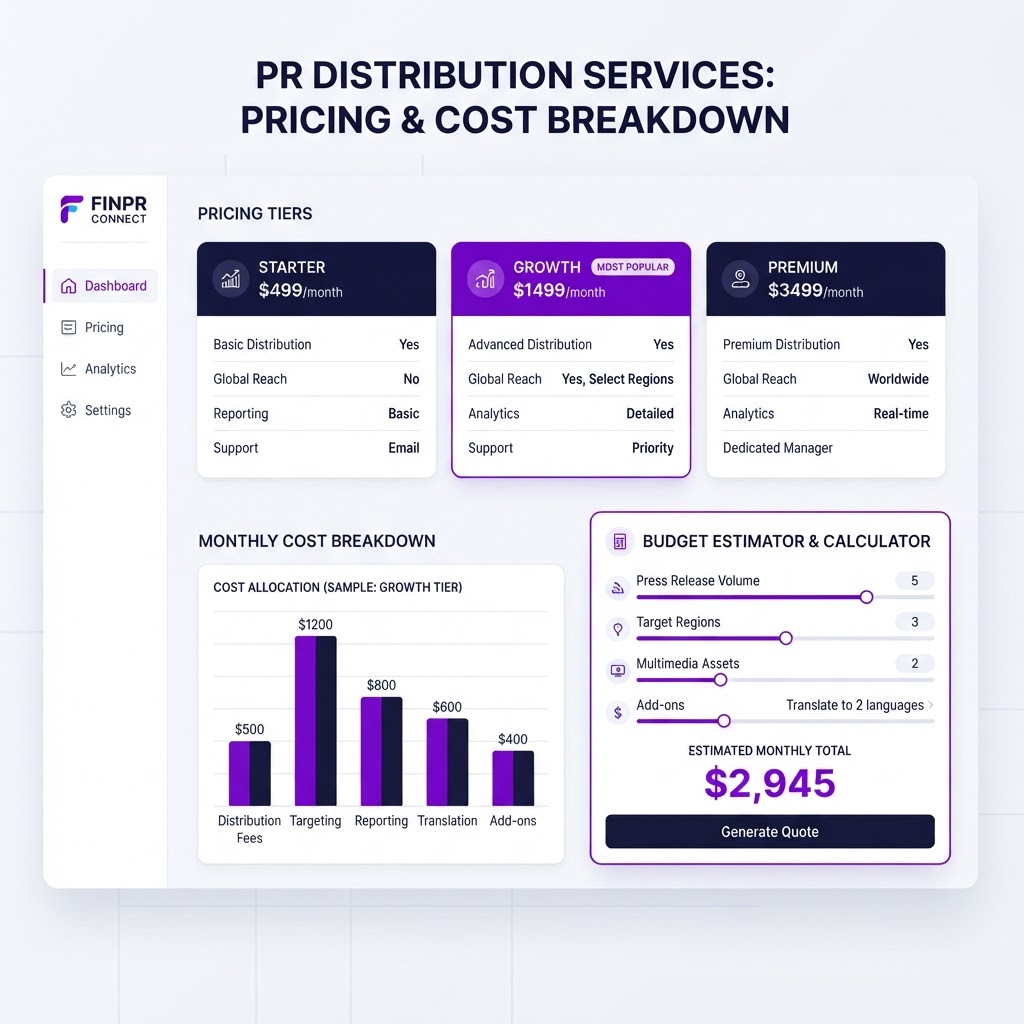
Press release distribution ranges from under a hundred pounds for basic online syndication to several thousand for the major global newswires - with the price driven by network quality, geographic reach, and what sits around the distribution itself.
In this guide you'll learn the typical price bands, what genuinely drives the differences, what's included (and quietly excluded) at each level, and how to compare services on something better than the headline number.
Prices across the industry change frequently, so it's a good idea to treat the bands below as orientation and get current quotes for anything you're actually planning.
What are the typical price bands?
Budget online distribution - tens of pounds to low hundreds per release - buys syndication across general networks: the record established, search presence created, no meaningful editorial reach.
Mid-market services - low hundreds to around a thousand - add stronger networks, geographic and industry targeting, media database delivery, and better reporting.
Premium and global newswires - several hundred to several thousand per release - carry the direct feeds into newsroom systems and financial terminals, the regulatory-grade distribution listed companies require, and international reach by region.
Add-ons at every level - multimedia embedding, translation, additional regions, guaranteed placements - price separately.
What actually drives the price differences?
Network quality above all - the gap between named, checkable outlets and anonymous "500+ sites" is the product, as our guides to how newswires work and media tiers explain.
Reach genuinely costs money where it's real: national and international distribution, financial terminal feeds, and translation are expensive inputs.
And reporting quality - live clickable URLs versus unverifiable "potential reach" figures - tracks price more reliably than almost any other signal.
What's included - and what's quietly not?
At every price level, check five inclusions before comparing numbers.
Distribution scope - which networks, which regions, and whether the named outlets you care about are actually in it.
Editorial handling - whether anyone reviews the release, or whether it flows through unread.
Reporting - a verifiable placement list, or a reach estimate.
Media contact delivery - whether journalists receive it, or only websites republish it.
And the recurring exclusions: images often cost extra, "premium" outlets sit behind upsells, and per-word limits turn a normal release into surcharges.
Is expensive distribution worth it?
It depends entirely on what the release needs to achieve.
For the record, search presence, and AI visibility, mid-market distribution typically delivers everything the premium tier does at a fraction of the price - the syndication layer is the syndication layer.
Premium earns its cost in specific cases: regulatory announcements, investor-facing news that must hit terminals, and international launches needing genuine multi-region reach.
What no distribution price buys is earned coverage - a journalist choosing to write about you - which comes from the story and the pitch, not the pipe, as our earned vs paid guide sets out.
How do I compare services fairly?
Ask each provider the same four questions.
Can I see a live placement report from a recent release - actual URLs, not a network list?
Which of these ten outlets I care about will receive or carry this - named answers, not percentages?
What exactly does the quoted price include, and what triggers extra charges?
And how do you report syndication versus any editorial pickup - separately, or blended into one "coverage" number?
The pattern in the answers tells you more than the prices do - and transparent separation of those numbers is precisely how we think reporting should work.
How do I spend a distribution budget well?
Match the tier to the release: routine announcements on efficient mid-market distribution, the handful of genuinely major moments on premium reach.
Spend the difference on what actually moves results - the story itself, better pitching, and measurement - because a modest release excellently distributed still loses to a strong story adequately distributed, every time.
How can I learn more?
See how Insider PR's distribution and pricing work, or continue with our guides to what a newswire does and measuring what your spend returns.
Disclaimer: We make reasonable efforts to keep the content of this article up to date, but we do not guarantee or warrant (implied or otherwise) that it is current, accurate or complete. Pricing examples are indicative only. This article is intended for general information purposes only and does not constitute advice of any kind. You should always seek professional or specialist advice before acting on the content of this article.
Put these PR techniques to work with targeted journalist outreach from our team.

Sam Allcock is the founder of Insider PR and a vastly experienced digital marketer specialising in digital PR, SEO, and online reputation management. He helps Fintech, Crypto and Tech founders own their search results through strategic media placements, newswire distribution, and guaranteed coverage on high-authority outlets. With over two decades in digital marketing, Sam has built and led multiple agencies and PR platforms, and his commentary has appeared in HuffPost, MSN, Business 2 Community, and a wide range of trade and consumer publications.
More pr tips
When should I use AI in PR outreach?
AI is at its most valuable in PR not when it writes your press release, but in the outreach stage - deciding who…
How do I write a press release using AI?
AI writing tools allow a business to draft, refine, and adapt press releases in a fraction of the time it would take…
Earned vs Paid Media: A Founder's Guide
What you actually control with each type of coverage, how long it lasts, and how to budget across them as an…