
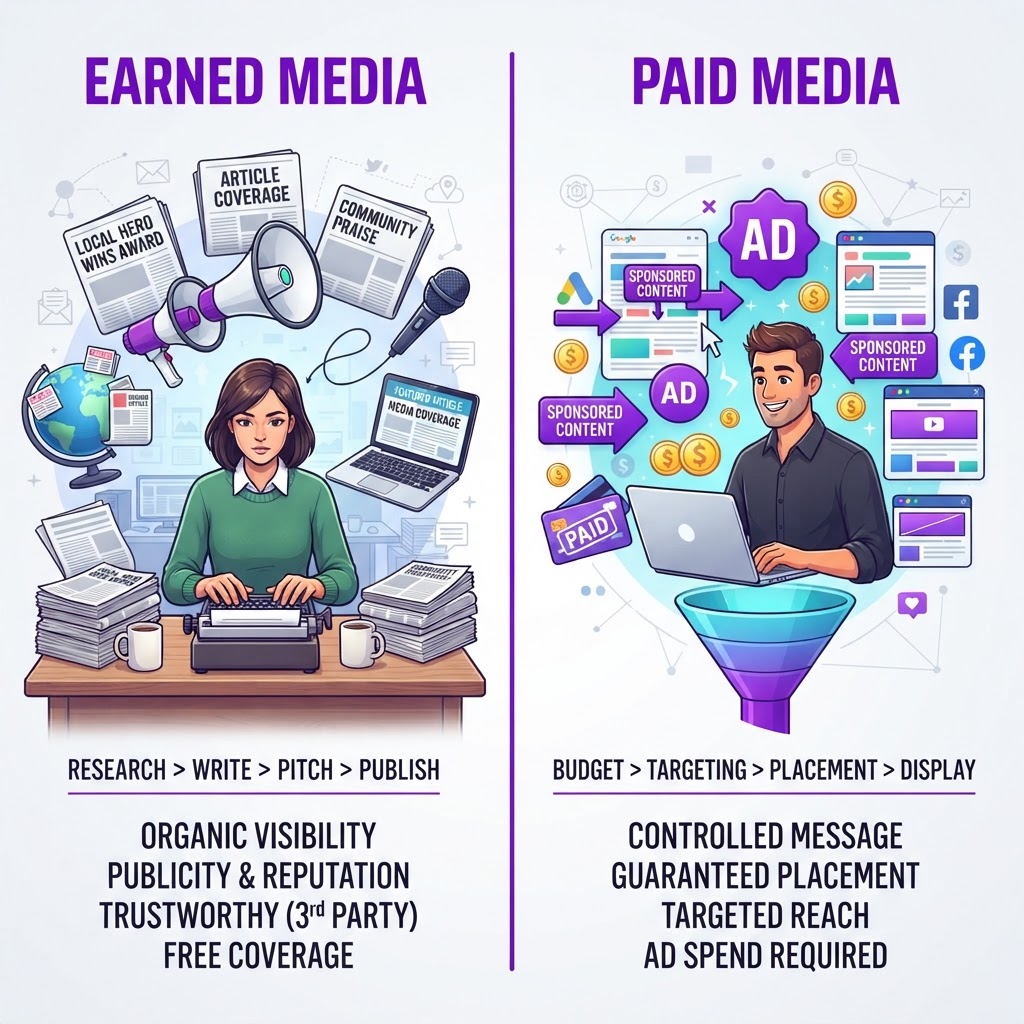
Earned media is coverage a journalist chose to write; paid media is placement you bought; syndicated coverage is your own content republished across a network - three fundamentally different things that too many coverage reports blur into one column called "coverage".
In this guide you'll learn what each actually is, what each is genuinely worth, how to tell them apart in thirty seconds, and when each is the right tool.
Understanding this distinction is the single most protective piece of knowledge a PR buyer can hold - because the industry's most common sleight of hand is selling one while implying another.
What is earned media?
Earned coverage exists because a journalist read your story and decided their readers should too - an editorial judgement you influenced but didn't control.
It's earned through a genuinely newsworthy angle, a well-targeted pitch, original data, or expert comment - and it can never be guaranteed, which is precisely why it's worth the most.
The value is third-party validation: an independent outlet staking its credibility on your story, with the trust, search authority, and AI-answer weight that follows.
What is paid media?
Paid placement is space you bought - sponsored content, advertorial, partner posts, and paid contributions - legitimate when disclosed, and disclosed placements are labelled ("sponsored", "partner content", "promoted").
Paid has honest uses: guaranteed timing and message control for launches, presence in outlets earned work hasn't cracked yet, and guaranteed placements where certainty matters more than editorial endorsement.
What paid is not is earned - the label journalists and increasingly readers check first - and passing one off as the other damages the brand doing it more than anyone.
What is syndicated coverage?
Syndication is your own release republished across a distribution network - the same story, photocopied, as our guide to how newswires work explains.
Its genuine value is infrastructure: the official record, your search results filled with your version of events, and presence in the material AI systems read.
Its non-value is readership - most syndication placements are read by nobody - and a report presenting five hundred syndicated copies as five hundred pieces of coverage is measuring photocopies.
How do I tell them apart in a coverage report?
Three checks, thirty seconds each.
Open the piece and look for a byline with a history - a named journalist who writes other original stories on that site signals earned; no byline, or "Staff"/"Newsdesk" atop your release verbatim, signals syndication.
Look for the label - "sponsored", "partner", "promoted" means paid, however editorial it looks.
Compare the text to your release - if the wording is yours, a journalist didn't write it; earned coverage paraphrases, adds, and sometimes says things you'd rather it didn't.
A provider who won't split their reporting into these three lines is telling you which line dominates - the audit questions in our guide to measuring PR campaign value follow directly from this.
What's each type actually worth?
Weighted honestly: one earned piece in a Tier 1 or strong Tier 2 outlet typically outweighs any volume of syndication, because trust, readership, links, and AI citation weight all concentrate there.
Paid sits between - real visibility, real control, discounted trust - and works best amplifying a story that has some earned validation behind it.
Syndication is the floor: cheap, useful, and honest as infrastructure, mispriced the moment it's counted as audience.
When should I use which?
Announcements that need to be on the record - distribute them.
Stories with genuine news value - pitch them for earned coverage, and protect them from the wire until pitching has run its course.
Moments needing guaranteed timing, placement, or message - buy them, disclosed, with eyes open.
Most effective programmes run all three deliberately - the failure mode is running one and reporting it as another.
How can I learn more?
Continue with our guides to media tiers, campaign measurement, and digital PR - or read how Insider PR separates editorial from syndication in its own reporting.
Disclaimer: We make reasonable efforts to keep the content of this article up to date, but we do not guarantee or warrant (implied or otherwise) that it is current, accurate or complete. This article is intended for general information purposes only and does not constitute advice of any kind. You should always seek professional or specialist advice before acting on the content of this article.
Ready to distribute? Reach journalists and outlets across our global newswire network.

Sam Allcock is the founder of Insider PR and a vastly experienced digital marketer specialising in digital PR, SEO, and online reputation management. He helps Fintech, Crypto and Tech founders own their search results through strategic media placements, newswire distribution, and guaranteed coverage on high-authority outlets. With over two decades in digital marketing, Sam has built and led multiple agencies and PR platforms, and his commentary has appeared in HuffPost, MSN, Business 2 Community, and a wide range of trade and consumer publications.
More digital pr
The Certainty Framework: A Clear Approach to PR in 2026
A decision-making model for PR teams under pressure. How to set control boundaries, choose the right level of…
What Is a Newswire and How Does Press Release Distribution Work?
What is a newswire? How press release distribution actually works, what it does (and doesn't) achieve, and how to…
What are Tier 1 publications?
Tier 1 publications are the most authoritative, widely read, and trusted media outlets in a given market. Here's what…